UPI fee from October 15: what changes when you pay a shop over ₹2,000
A 0.4% merchant fee arrives on larger UPI payments to businesses. Customers should not pay a rupee more, and most everyday payments stay free.
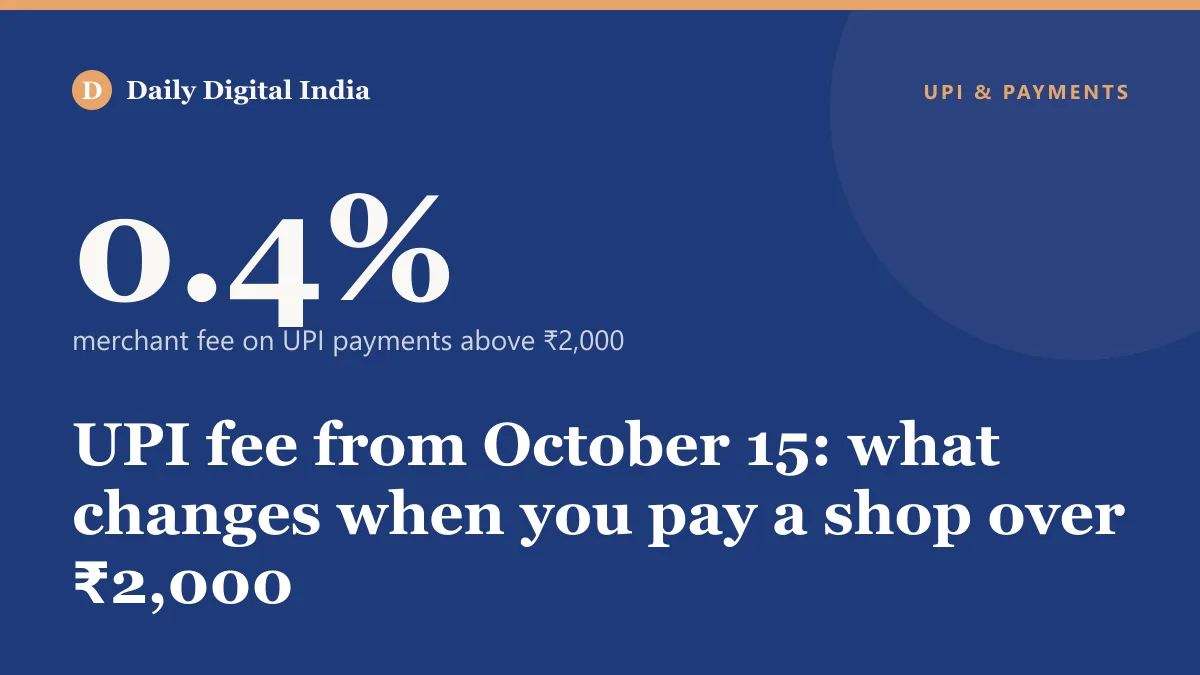
For most of its life, UPI has cost shops nothing to accept. That ends for a slice of payments on 15 October 2026, when a fee called the merchant discount rate (MDR) starts applying to larger person-to-merchant payments.
The headline number is 0.4%. The more useful number for shoppers is zero: the fee sits with the business, and banks have been told to make sure merchants do not pass it on to customers.
What exactly changes
NPCI announced the framework in mid-September, alongside a Ministry of Finance notification that keeps small UPI payments charge-free. In short:
- Payments to a business above ₹2,000 attract an MDR of 0.4%, paid by the merchant. The fee stops growing at ₹300, which it reaches at ₹75,000.
- Essential, thin-margin categories such as railways, telecom, insurance, fuel and agricultural inputs pay a flat ₹5 per payment above ₹2,000 instead.
- Capital-market payments (mutual funds, brokers and similar) pay 0.02%, also capped at ₹300.
- Everything at ₹2,000 or below stays free, and so does every person-to-person transfer, whatever the amount.
- Small merchants, including street vendors, who receive up to ₹1 lakh a month through UPI QR codes keep paying nothing at all.
The government estimates that only about 4% of merchant payments fall inside the new fee. The rest are either too small or come from exempt sellers.
What it costs, in rupees
Here is what a business would pay on a few ordinary bills under the standard 0.4% rate:
| Payment to a shop | Fee paid by the shop | What you pay |
|---|---|---|
| ₹1,800 grocery bill | ₹0 (below ₹2,000) | ₹1,800 |
| ₹2,500 pharmacy bill | ₹10 | ₹2,500 |
| ₹10,000 phone repair | ₹40 | ₹10,000 |
| ₹50,000 laptop | ₹200 | ₹50,000 |
| ₹1,20,000 furniture order | ₹300 (cap) | ₹1,20,000 |
| ₹3,000 at a fuel pump | ₹5 (flat rate) | ₹3,000 |
Notice the last column never changes. The fee comes out of what the merchant receives, much like the charge a shop already pays when you swipe a card.
Will shops start adding a surcharge?
They are not supposed to. The framework separates the merchant's fee from anything charged to the payer, and banks are responsible for making sure merchants do not add MDR to the customer's bill. UPI apps are also barred from adding platform fees or hidden charges of their own.
In practice, some shops may still try a "₹20 extra for UPI" line, as a few already do with cards. If that happens, you can ask them to remove it, pay another way, or report it through the help section of your UPI app with the transaction reference.
Why now
UPI has grown into the default way to pay in India, but banks and payment apps have carried most of its running costs. The MDR gives them a revenue stream from the payments best able to bear it, larger bills at established businesses, while keeping small payments and small sellers untouched. Five per cent of what is collected is set aside to help more small merchants accept UPI.
What to do as a customer
Nothing changes on your phone. You scan, pay and get the same confirmation as before. Two habits still help:
- Check the final amount on the payment screen before you enter your PIN, especially at shops you do not visit often.
- Keep the reference number of larger payments. If you ever need to dispute a surcharge or a failed payment, it is the first thing your bank will ask for. Our guide to failed UPI payments and refund deadlines explains what happens next.
The ₹2,000 line is also unrelated to how much you can send in a day. Those caps are separate and differ by category; we list them in UPI limits explained.